
If your team builds and runs data platforms for a bank, NBFC, insurer, or fintech in India, the Digital Personal Data Protection (DPDP) regime is now yours to design around. The encouraging part: most of what it asks for maps onto controls you can build on AWS. The work is putting the right control in the right place, and being able to prove it holds.
This post walks through how to do that: what to build, where consent and purpose actually get enforced, how to govern AI on personal data, and a roadmap you can start on now. The legal interpretation stays with your compliance team. This is the engineering view.
The deadline you're building toward
DPDP rolled out in phases, so you have a runway, though not a long one. Here's the shape of it.
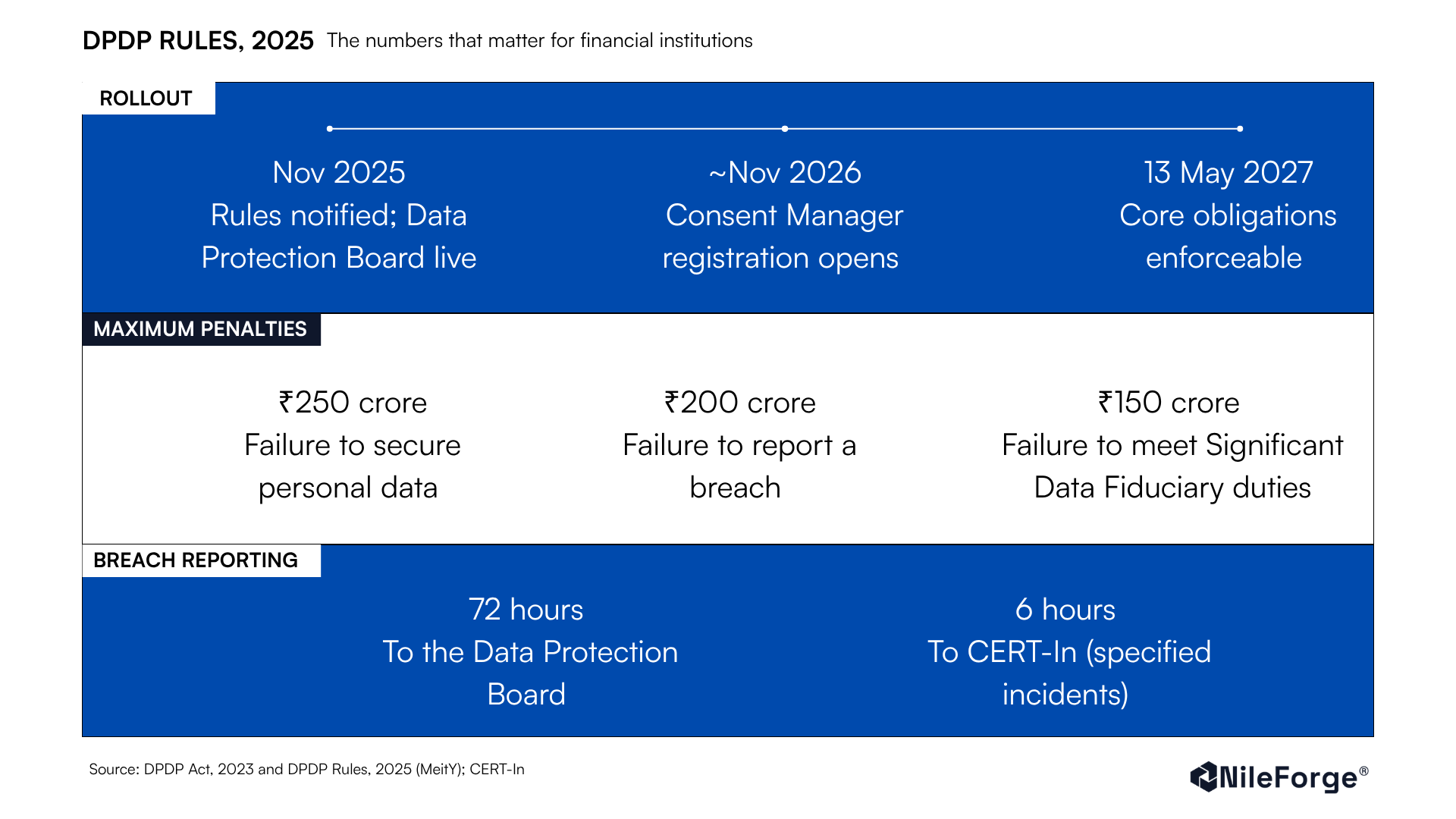
What's already live: the Rules are notified and the Data Protection Board is up and running.
What's still ahead: Consent Manager registration opens around November 2026, and the core obligations (notice and consent, security safeguards, breach reporting, retention, individual rights) land at the 18-month mark. That makes 13 May 2027 the date to build toward, with soft enforcement expected through 2026.
Two numbers will frame your design. The ₹250 crore figure is a statutory ceiling for a finding of inadequate safeguards, not an automatic fine for one misconfiguration; the Board decides the actual penalty. And the DPDP 72-hour breach report is separate from CERT-In's 6-hour report for specified incidents, with different triggers and recipients, so a single event can trip both clocks. You build for both.
Why this lands on your architecture, not your policy team
Four things push DPDP into system design:
- Regulators overlap. You already answer to RBI, SEBI or IRDAI, plus DPDP and CERT-In, so build once to the strictest bar instead of stitching together separate control sets.
- Consent and purpose live in the data. KYC collected for a legal duty is not transaction data reused for cross-sell, and if your platform can't tell them apart per record, it can't honor or prove either.
- The breach clock is really a detection problem. You can only report fast if you already know where personal data sits and can trace who touched it.
- Retention and erasure are pipeline jobs. At Indian transaction volumes, deletion and rights requests can't be manual.
Five things a DPDP-ready foundation needs on AWS
AWS secures the cloud; you secure what you run on it. So DPDP compliance on AWS is something you design, not something the platform hands you. Five building blocks:
- Classify and find your personal data. Stand up a simple scheme (Public, Internal, Confidential, Restricted), then let Amazon Macie discover and classify it, tags label it, and AWS Glue with Lake Formation keep the catalog and lineage. Everything else, rights requests, erasure, breach scoping, builds on this.
- A region-controlled baseline. Run in AWS's Mumbai and Hyderabad Regions and make residency enforceable with AWS Control Tower, Organizations, and service control policies, encrypted with AWS KMS. On localization: DPDP restricts transfers to certain countries rather than mandating blanket localization, and the RBI payment-data rule applies only to payment system operators and participants, not every institution.
- Access that knows purpose and consent. This is the part teams most often get wrong. IAM Identity Center, Lake Formation, and KMS control who and what can reach data, but they don't enforce consent by themselves. You add that above the platform: purpose tags on data, a consent record of what each person agreed to, Consent Manager integration once it's live, and the enforcement logic in your application. The AWS primitives are necessary, not sufficient.
- Bounded retention and clean erasure. Use S3 Lifecycle rules and automated deletion to make retention routine, with S3 Object Lock where records must stay immutable. The hard part is reconciling DPDP erasure with the records RBI and anti-money-laundering law require you to keep.
- Breach detection and response. Wire Amazon GuardDuty, CloudWatch, CloudTrail, and AWS Security Hub into runbooks built around the reporting clocks, so detection, tamper-evident logging, and a single view of posture are ready before you need them.
Governing AI and GenAI on personal data
Personal data is still personal data once it's inside a model. Carry the same controls across the AI lifecycle:
- Training and fine-tuning need a lawful basis and a purpose limit, so minimize or de-identify personal data in your training sets.
- Retrieval (RAG) has to respect the source data's permissions, so no one reaches through a model to data they couldn't reach directly.
- Prompts and inference should redact personal data, log for traceability, and keep a human in the loop for decisions like credit or claims.
Amazon Bedrock Guardrails can filter and redact personal data, but the governance and access calls stay yours. For Significant Data Fiduciaries, this is also the due diligence you'll owe over algorithmic systems, and it lines up with the RBI's direction on responsible AI in finance.
Prove it continuously, not at year-end
DPDP rewards what you can show. The same services that enforce your controls can generate the evidence as you go:
- AWS Config tracks every resource's configuration over time, checks it against rules and conformance packs, and can auto-remediate drift.
- AWS Security Hub rolls findings into one security posture against recognized standards, with history.
- AWS CloudTrail keeps a tamper-evident record of who did what, so you can reconstruct and scope an incident.
- AWS Audit Manager maps that evidence to control frameworks, turning an audit into a review of a standing record.
A note on Significant Data Fiduciaries (SDFs). The government designates SDFs by notification, based on things like data volume and sensitivity. It's not self-declared, and you don't carry SDF duties until you're named one. Large banks, insurers, and payment aggregators are widely expected to be candidates, and the duties that follow (a DPO, annual impact assessments, audits, algorithmic due diligence) are far easier when your evidence is already continuous. AWS's own ISO 27001, SOC, and PCI DSS attestations are in AWS Artifact; they support your program, but the DPDP outcome is still about what you build.
Your DPDP-on-AWS roadmap
You don't have to re-platform on day one. A practical order:
- Map your personal data first. It answers what every other control depends on.
- Lock down residency and the baseline. It's quick to stand up and removes a whole class of risk.
- Instrument breach detection and logging early, before you need it.
- Build the consent and purpose layer: consent records, purpose tags, access decisions.
- Automate retention and erasure, starting where data volumes are highest.
Close the biggest gaps with the least disruption, and make sure each step leaves evidence you can show a regulator.
Start now, while you have runway
The teams that will find 2027 manageable are building DPDP into their architecture today: classification, residency, purpose-aware access, automated retention, fast breach response, and continuous evidence, while there's still time.
If you're a CTO, CISO, CIO, or head of data or platform engineering at a bank, NBFC, insurer, or fintech mapping DPDP onto your AWS environment, we can help. Request a DPDP-on-AWS readiness assessment, and we'll review your setup against the building blocks above, flag the gaps that matter most, and map the fastest path to close them.
About NileForge
NileForge is an AWS cloud, data, and AI engineering company. We design, build, and run secure systems on AWS for financial services across banking, payments, insurance, and capital markets, from regulator-ready foundations to production AI. If your team is working through DPDP readiness on AWS, we're happy to talk, builder to builder.